Currents of Imagination: Death Illuminating Life

Updated: May 4
In this Currents of Imagination piece, I share notes from a conversation with Kristian Brevik, artist, writer, and lecturer in ecology, evolutionary science, and environmental humanities, about his series of whale lanterns that invite us to meditate on death, connection, and responsibility.
---------------
To begin, we must sink.
a heavy thing in one world
floats like willow seed in a breeze
in this,
a moving vast through
that darkness, silent ...
they don’t need
much else—oxygen, nor light—
the frilled shark
and fang-tooth, the spider crab,
the vampire squid, who strip the dead
down now
beyond bones
to the merest blueprint of
whale…
Whale fall is a natural phenomenon that gives life to the dead. More than 3,000 feet beneath the sea, whale bodies are slowly remade. In that briny dark, soft tissue dissolves into nutrient-rich food, and vast bones become habitat.
Whale fall marks not just the transformation of the whale’s body, but a profound shift in its relationship with the world.
Stitching Possible Futures
Like whale fall, death is not the end for Kristian Brevik. Transformation and connection are creative threads in his Whalefall Light and Sculpture series of hand-sewn muslin whale forms, which, when lit, emit a warm ethereal glow and cast shadows of their skeletons.
Dubbed ghost lanterns, they serve, in his words, as “reflections on life under threat,” driven by human action.

In his zine To Light a Candle is to Cast a Shadow, Kristian writes that the lanterns stand as memorials to lives lost and to losses yet to come if we do not change.

This idea of death illuminating life is ancient. Across many forms and traditions, we’ve lit candles and lanterns to honor those who’ve died. Their light often represents the deceased’s enduring spirit and hope for the future, and can serve as a guide for the dead.
Kristian’s ghost lanterns feel like part of this lineage. The first time I saw one, I was transported to a special place: standing in its dim interior, small flickers of light pierced the darkness, calling me to remember how we are intertwined.
Connected to the Sea
Kristian’s life began next to the sea, close to the lives moving in and under the water.
His dad fished and built wooden boats, and, nestled in his mom’s sewing room, he made costumes and clothes under her watchful eye. The family home also hummed with a subtle tension, as his mom gave gentle individuality to his dad’s catches, calling them “buddies.”
Kristian said that the different ways his parents connected with our more-than-human kin “taught (me) a lot about how one always has an orientation towards other species and our relationships with them.” Proximity to the sea and these early lessons drew Kristian to whales, and the handcraft traditions passed down by his parents live on in the Whalefall series.
Honoring the Dead
Whalefall began as a response to historic industrial whaling, when whales were
hunted for their blubber to burn as oil for lighting, a practice that hollowed out whale populations worldwide and still shapes their recovery. Early work in Kristian’s series also centers on whale entanglement, another major driver of declining whale populations.
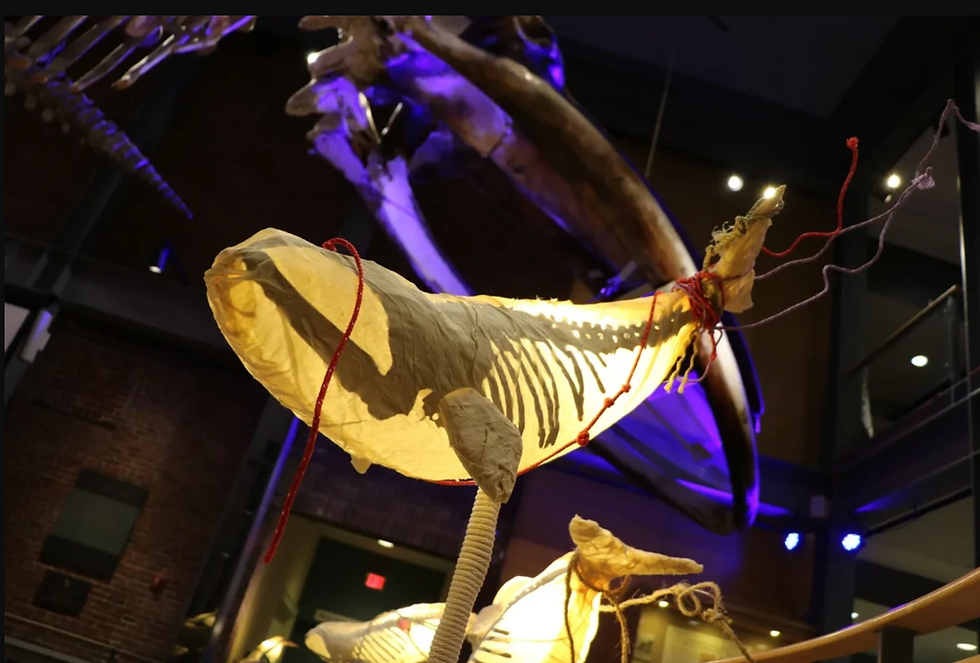
In the face of these stark realities, Whalefall opens a quiet, introspective space to commune with whales. Kristian’s reverence for whales shines through in his focus on simple, recognizable forms and his use of biodegradable materials. These ghost lanterns do not sensationalize death, but allow us, in his words, to “turn towards” the whales.
This turning towards is a guiding light in his work. He believes we’ve been “cut off” from other species and hopes that the ghost lanterns act as a kind of repair, a way to take ownership and “reflect on death and the ways we as individuals and collectives relate to other species.”
The series' future path, as I understand it, is a return to ritual collective storytelling, in which audiences and performers build commemorative space with other living beings through light, shadow, and movement.

Balancing Light and Shadow

I’ve followed Kristian’s work for some time, and last year bought a lantern of my own. The gray whale gently floats above my dresser, connecting me to the sea, to the whales I’ve watched from rocky cliffs, to lives that continue after death, and to my responsibility to them.
To paraphrase Kristian: the next time you are at the shore with the tiniest crabs, plovers, or even whales, greet the places and individuals who are there with you by name. Begin the repair there.
Author’s Note
Maybe stories arrive when you need them. I interviewed Kristian in late January; a few days later, my mom died. My relationship with her physical body has changed. Now I’m reimagining our relationship in death, in the way his lanterns make possible.


Comments